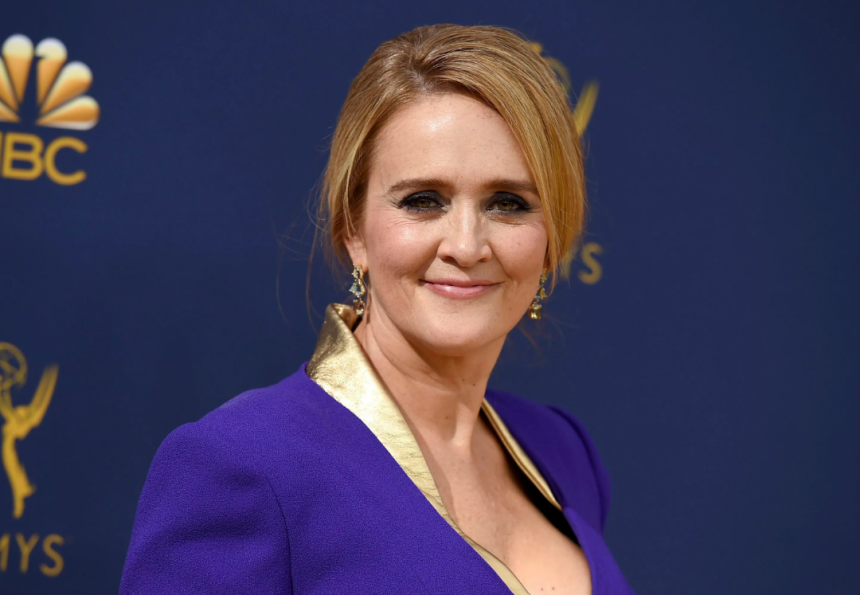
Samantha Bee has emerged as one of the most distinctive and influential voices in contemporary political satire. With a career spanning decades, she has successfully transitioned from correspondent to cultural commentator, reshaping the way audiences engage with political discourse in an increasingly fragmented media environment.
Bee first gained widespread recognition as a correspondent on The Daily Show, where her sharp wit and fearless approach to controversial topics quickly set her apart. Unlike many of her peers, she demonstrated a willingness to go beyond surface-level humor, often embedding herself in politically sensitive environments to deliver deeply contextualized segments. This commitment to immersive storytelling became a defining characteristic of her work.
Her evolution reached a new peak with the launch of Full Frontal with Samantha Bee. The show marked a significant shift in late-night television, not only because of Bee’s role as one of the few female hosts in the genre, but also due to its unapologetically direct tone. Rather than maintaining a detached comedic stance, Bee positioned herself as an active participant in political conversations, blending satire with advocacy.
What distinguishes Bee’s approach is her ability to merge humor with urgency. Her segments often tackle complex issues such as immigration, reproductive rights, and systemic inequality, presenting them in a format that is both accessible and intellectually engaging. This balance has allowed her to reach audiences who might otherwise disengage from traditional political analysis.
In addition to her on-screen work, Bee has played a critical role in expanding the scope of political comedy as a tool for social commentary. She has consistently challenged the conventions of the genre, pushing beyond entertainment to provoke meaningful reflection and, at times, direct action. Her work demonstrates that satire can serve not only as a mirror to society but also as a catalyst for change.
However, Bee’s career has not been without controversy. Her outspoken style and willingness to address polarizing topics have occasionally drawn criticism. Yet, it is precisely this willingness to take risks that underscores her relevance in today’s media ecosystem. In an era defined by rapid information cycles and ideological divides, Bee’s voice remains both disruptive and necessary.
Ultimately, Samantha Bee’s legacy lies in her ability to redefine the boundaries of political satire. She has transformed it from a peripheral form of commentary into a central force within modern media, proving that humor, when wielded with precision and intent, can be one of the most powerful tools for understanding the world.